- Age Strong, Live Long!
- Posts
- The Power of Posture - Part 1
The Power of Posture - Part 1
Age Strong, Live Long! Newsletter - Issue #4

Bob Shaw
September 15, 2025


The Power of Posture - Part 1 & 2
This issue of Age Stong, Live Long! is Part 1 of a 2-part series about the importance of posture- especially for adults 45+, and how to increase postural awareness through a simple self-assessment. The next issue (Part 2) will feature a simple, yet comprehensive, posture strength, endurance and mobility training program for beginners.
Why Posture Matters (Especially After 45)
Posture isn’t just about “standing up straight.” It’s the foundation for how our body moves, breathes, and ages. For adults 45 and older, posture strength and endurance become even more critical. As muscles naturally weaken with age and bone density shifts (unless we actively maintain muscle and bone density), poor posture can accelerate pain, injury risk, and mobility loss. Conversely, strong, upright posture (referred to as neutral posture) supports balance, breathing, circulation, and independence well into later years.
The Modern Posture Problem
Our digital lifestyle has reshaped the way we carry ourselves. Hours spent sitting at computers and looking down at phones train the body into chronic poor posture- rounded shoulders, weak glutes and core, and the all-too-common forward head tilt that sometimes results in “tech neck.” Each inch the head moves forward effectively doubles the strain on the neck and upper back. I call this modern poor posture “digital lifestyle posture.”
Note: Several studies show that the incidence of mobile device-related neck pain is significantly higher among Gen Z (16 to 26-year-olds) compared to Baby Boomers (61-79). This evidence suggests that while tech neck is rising across all age groups, the rate and burden appear disproportionately higher among younger, digital-native individuals—likely because of heavier cumulative exposure and early-life posture habits. Chronic and persistent device overuse may outweigh age as a reason for posture deterioration.

“Digital Lifestyle Posture”
Posture is now considered a longevity marker, just like VO₂ max or grip strength. Over time, poor posture leads to:
Increased back and neck pain (more device use while in poor posture = more pain)
Headaches and fatigue
Shallow breathing and reduced oxygen intake
Higher fall risk due to misaligned balance (Per Dr. Peter Attia, the statistics on fall-related hip fractures for 65+-year-olds are grim… 15% to 30% die within one year of hip fracture)
What Good Posture Means Today
Modern science redefines posture as dynamic alignment—not holding a stiff pose, but maintaining neutral spinal curves, efficient muscle engagement, and adaptability across positions (neutral posture). Key markers of neutral posture are:
Neutral spine with natural curves maintained
Ears over shoulders, shoulders over hips, hips over ankles
Core, glutes, and spinal stabilizers lightly engaged (more on this in Part 2)
Freedom to breathe deeply and move efficiently
Simply put: better posture = stronger aging.
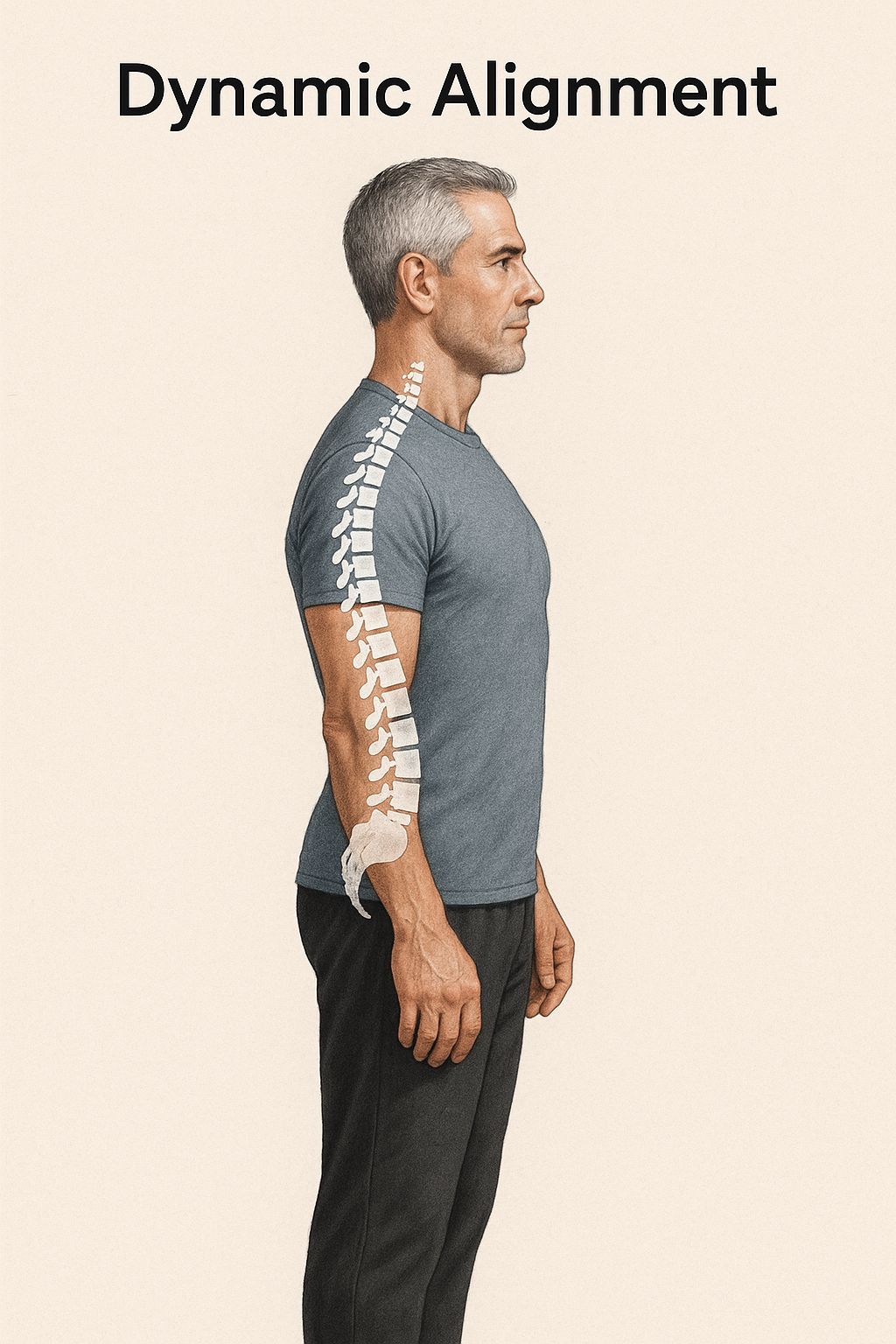
“Neutral Posture”
Posture Awareness and Self-Assessment
Improving posture begins with awareness. Before you can strengthen or correct it, you need to understand where your body is right now in relation to true neutral alignment. A simple but comprehensive self-assessment provides that baseline. In the following video, I walk through five fundamental movements that will allow you to find and feel digital lifestyle posture and then reverse engineer that poor postural alignment into neutral posture—the position where your spine, core, and stabilizing muscles are working together most efficiently.
📌 Digital Lifestyle Posture: 5-Step Self-Check
Step 1 – Hips
🎯 Goal: Pelvic “bucket” level
❌ Digital posture: Pelvis tucked under, glutes off, hamstrings tight
✅ Self-check: Hands on hips—does your tailbone tuck under?
➕ Adjustment: Tilt hips forward until you feel a gentle natural arch in the lower back.
Step 2 – Abdominals
🎯 Goal: Abs engaged like a corset
❌ Digital posture: Abs soft and disengaged
✅ Self-check: Hand on stomach—lightly firm or completely relaxed?
➕ Adjustment: Lightly engage abdominals, as if bracing for a gentle tap without holding your breath.
Step 3 – Mid-Back
🎯 Goal: Upright thoracic spine
❌ Digital posture: Upper back rounded forward
✅ Self-check: Hand across upper chest—does your hand rise when you “stick out your chest”?
➕ Adjustment: Extend through the mid-spine so you’re standing tall; hold that upright, open position.
Step 4 – Head Position
🎯 Goal: Ear stacked over shoulder
❌ Digital posture: Head juts forward
✅ Self-check: Mirror view—are your ears in front of your shoulders?
➕ Adjustment: Place a finger on your chin and gently push your head back (chin tuck) until ears align directly over shoulders.
Step 5 – Shoulders
🎯 Goal: Shoulders neutral, palms toward thighs
❌ Digital posture: Shoulders rotated inward, palms backward
✅ Self-check: Arms at sides—are palms facing behind you?
➕ Adjustment: Externally rotate shoulders until palms face inward toward your thighs, with shoulder blades resting low and gently squeezed toward the spine.
Downloadable Version:
|

Next Up… “The Power of Posture - Part 2”
In Part 2 of this series, we’ll move from awareness into action with a step-by-step training program designed to build posture strength, endurance, and mobility—practical tools you can integrate into your daily life to support balance, resilience, and longevity.
Previous Issue of “Age Strong, Live Long!”
Since the launch of this newsletter, I’ve gotten requests by new subscribers to forward links to the first three issues. Issues #1, #2 and #3 are below.

Physical Structure, Inc. - Personal Fitness Coaching
If you would like to learn more about Physical Structure coaching services by scheduling a free 15-minutes consultation, please E-mail me at [email protected] or visit our website at the following link:

Bob Shaw - Fitness Coach - Founder, Physical Structure, Inc.
Thanks again for being part of the Age Strong, Live Long! community!
Until next time…